Introduction
"How to take fish off hook"It is not merely a hobby; it is an art form. Just as catching a fish is essential, so too is the proper technique for removing the hook. If this task is performed incorrectly, the fish may sustain injuries or suffer harm; therefore, through this article, we will explain in detail how to safely and correctly remove a hook from a fish.
Why is it important to remove the fish from the hook?
When a fish gets caught on a hook, it often thrashes about. During this struggle, the fish may sustain injuries, the hook can become embedded deeply, and there is a risk of injury to one's hands.Therefore, it is absolutely essential to use it correctly, so that the fish sustains minimal harm.
Necessary items for removing a fish from a hook
here are some important tools to get the fish out correctly.
1.Piers
This is the most essential tool. With it, you can easily grip and remove the hook.
2.Fish gripper
This makes it easier to catch the fish, and reduces the risk of one's hand slipping.
3.Gloves
Wearing gloves keeps your hands safe—especially if the fish has sharp teeth.
4.Hook Remover
This is a specialized tool that helps remove hooks quickly and safely.
Correct Method for Removing a Fish from a Hook
We will explain to you, step by step, how to remove a fish from a hook.Step 1.Cool the fish
After removing the fish from the water, hold it gently; do not grip it too tightly, as doing so will cause it to struggle even more.
Step 2Hold it properly.
Catch small fish by hand and use a gripper for larger fish and do not apply too much pressure to the fish's body.
Step 3Check the position of the hook.
First, check where the hook is snagged.
If the hook is outside the mouth → it is easy to remove.
If the hook is lodged inside → caution is required.
Step 4Gently remove the hook.
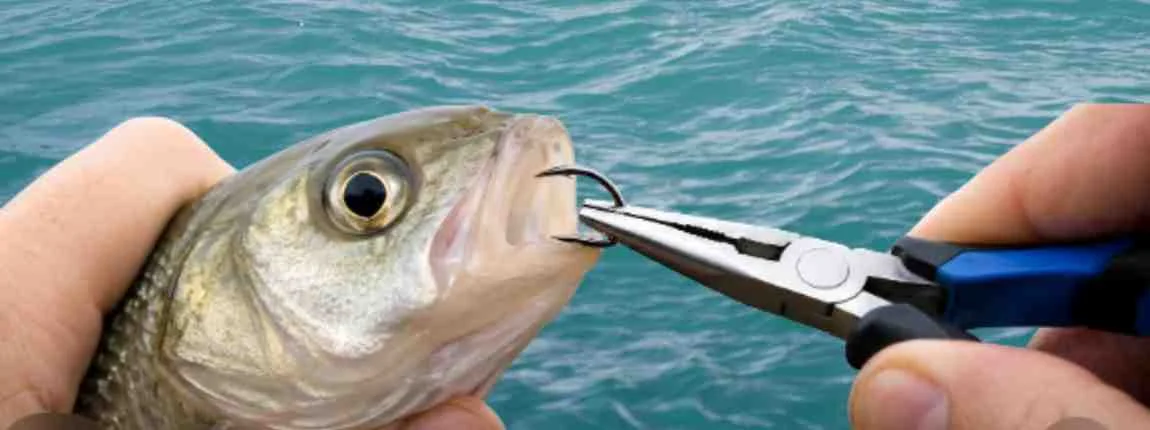
Grip the hook with pliers.
Remove it in the same direction in which the hook entered.
Avoid pulling forcefully.
Step 5Release the fish back into the water.
If you are practicing "Catch and Release," gently release the fish back into the water so that it can recover quickly.
What to do in different situations?
1.When the hook gets stuck deep
If the hook has gone in too deep:
Do not force the hook out.
Cut the line.
Leave the fish.
This method is the safest for the fish.
2.Use of Barbless Hooks
Hooks of this type do not have barbs, making it comfortable and safe to remove the fish.
How to fish and protect yourself?
✔️For fish.
Do not keep the fish out of water for a long time.Always keep your hands wet so that the skin of that fish remains safe.
For your safety
Always wear gloves on your hands.
Be careful of the fish's teeth and fins yourself?
Keep a little distance from the hook.
Common mistakes to avoid.
1.Pulling the hook too hard can injure the fish.
2. Handling the fish with dry hands can damage its skin.
3. Always be patient; do not ru
4.Make sure to use the right tools instead of the wrong ones.
Tips
Always keep a pair of pliers with you, use barbless hooks, and never keep the fish out of the water for too long; continue to practice and gain experience—this will help you improve.
Environment and responsibility!
We should be mindful of nature while fishing. Never overfish; release small fish back into the water, and always keep the water clean
Conclusion
Fishing is an art form that every angler must master. By utilizing the correct techniques and equipment, you can perform this task with both ease and safety; this not only ensures the well-being of the fish but also safeguards your own safety.
If you are just starting out, practice gradually. And be patient; remember that a good mind is one that treats both the artificial and the natural with equal regard.